A passing check is a claim about what ran, not what's true
TL;DR — A green check tells you a code path ran and produced the value it was compared against. It does not tell you the subject was examined. Six independent bugs in one month, across four unrelated codebases, were all the same shape: something reported success for a region it never looked at. Jump to the checklist.
I hit this six times in a month. Different languages, different repos, no shared code: a JavaScript data package, a Python MCP server, a shell wrapper, a TypeScript PWA. Every one of them produced a clean result for something that was never actually examined — not a wrong answer, an absent answer, dressed as a pass.
That’s a nastier failure than a wrong answer. A wrong answer is a signal. An absent answer that reports itself as a pass is silence you’ve been trained to read as safety.
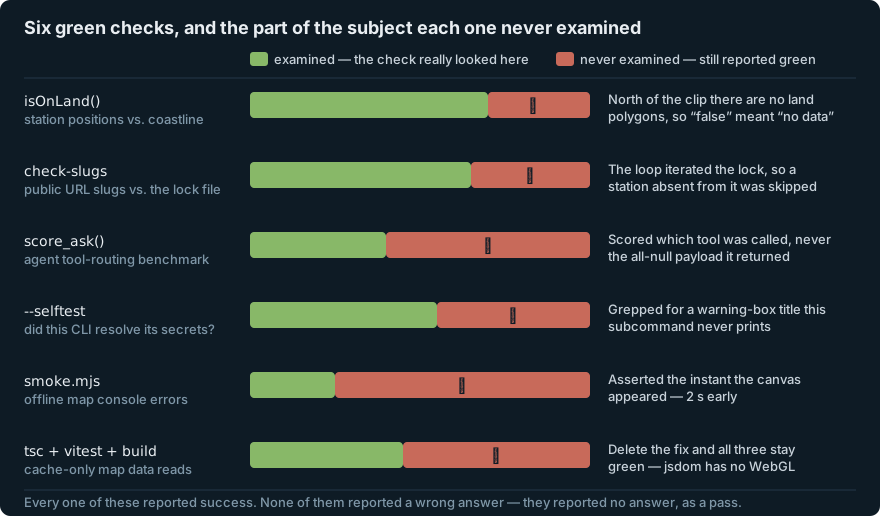
Here they are, shortest first, each with the rule I’d generalize out of it.
1. A boolean that returns false for “no” and for “I can’t tell”
station-corrections
exists to audit the published positions of tide and current stations. Its
headline check: is this station’s coordinate sitting on land? That’s a
point-in-polygon test against a bundled coastline:
// src/coastline.js — before
export function isOnLand(lat, lon) {
  const at = point([lon, lat]);
  return coastline.features.some((feature) => booleanPointInPolygon(at, feature));
}
The coastline ships clipped to a bounding box — the full planet coastline is far
too large to bundle. Outside that box there are no polygons, so some() finds
nothing and the function returns false. Which is byte-identical to the answer
it returns for a station verified to be in open water.
Three CHS current gates — Blackney Passage, central Johnstone Strait, Weynton Passage — sat north of the clip. The audit reported them valid. It had never looked at them. And the registry was growing north, so the silent region was growing too.
The fix is a coverage predicate derived from the data rather than hardcoded, so rebuilding the coastline with a different clip updates it for free:
// src/coastline.js — after
export function isWithinCoverage(lat, lon) {
  const b = coverageBounds();   // walked off the bundled polygons, memoized
  return lat >= b.minLat && lat <= b.maxLat && lon >= b.minLon && lon <= b.maxLon;
}
Then the second-order fix, which matters more: a registry station outside
coverage became a validation failure, not a note — and the coastline build
script now derives its clip box from the registry’s own extent plus a margin,
floored at the proven box so it only ever grows outward. The clip can no longer
fall behind the data it’s meant to check
(7d52f67,
1c06273).
Rule: a predicate over partial data needs three states, not two. If “no” and “I have no data here” collapse to the same value, every caller that reads
falseas a verdict is reporting a result it never computed.
2. A validator that iterates one side of a pair
Same package, next day. Station slugs are public URL segments, so a rename is a
breaking change. A lock file pins the slug each station last shipped with, and
check-slugs runs in CI ahead of the data checks:
// src/slugs-lock.js — before
for (const [id, lockedSlug] of Object.entries(lock.slugs)) {
  const nowSlug = current.get(id);
  if (nowSlug === undefined || nowSlug === lockedSlug) continue;
  // ...fail if the slug moved without the old value in formerSlugs
}
Read the loop bound. It iterates the lock. A station present in the data but absent from the lock is never visited — so a brand-new station’s slug entered the public API with nothing pinned to compare against, and that slug plus every future change to it passed green forever. The one thing the lock exists to prevent was invisible for exactly the stations most likely to get renamed: the new ones.
The guard is now symmetric — the lock must reflect the current knowable slugs exactly, in both directions:
// src/slugs-lock.js — after
for (const [id, lockedSlug] of Object.entries(lock.slugs)) {
  const nowSlug = current.get(id);
  if (nowSlug === undefined) {
    problems.push(`${id}: in the slug lock but no longer in the data — its slug "${lockedSlug}" is dead`);
    continue;
  }
  // ...moved-slug check unchanged
}

for (const [id, slug] of current) {
  if (!(id in lock.slugs)) {
    problems.push(`${id}: slug "${slug}" is not in the lock — run \`station-corrections slugs\``);
  }
}
The commit message named the pattern out loud, because it landed a day after the
coastline one: “Same failure class as the coverage bug: a clean result for
something never checked”
(99afa20).
Rule: a validator comparing two collections must iterate their union. Iterating one side can only ever find disagreements about things both sides already know about — which is the easy half of the problem.
3. A benchmark that scored the call, not the result
I run a benchmark over the boat agent’s MCP tool routing: a set of golden asks, each with the tools a correct answer requires. Scoring:
# poseidon/bench/scoring.py
def score_ask(ask, observed_tools, observed_args=None):
    if not set(ask.expected_tools).issubset(set(observed_tools)):
        return False
    # ...optional argument matching
    return True
Set containment on tool names. It measures routing — did the model reach for
battery_state when asked about the batteries — and routing is genuinely what
the benchmark was built to compare across models. But nothing in that function
ever opens the payload.
Meanwhile, in signalk-mcp:
async def battery_state(client: SignalKClient, bank: str = "0") -> dict:
    raw = await client.get_value(f"electrical.batteries.{bank}")
"0" is the SignalK instance convention, and it’s a perfectly reasonable
default — except the vessel publishes electrical.batteries.house. So the bare
tool returned this, on a boat that had been publishing battery data the entire
time:
{"bank": "0", "soc_fraction": null, "voltage": null, "current": null, "display": null}
Right tool, right arguments, no data. Score: match. The agent only got a real
reading if the person asking happened to say the word “house”. This survived
months of green benchmark runs and was found by hand, mid-benchmark, reading a
transcript for an unrelated reason
(e837d92).
The tool fix is small — try "0", then discover the vessel’s own banks off the
electrical.batteries subtree, and never second-guess an explicitly named bank
because answering about a different battery is worse than answering “no data”.
The interesting fix is the scoring one: at least one assertion per ask has to
reach into the returned payload.
Rule: a score computed from the call examines your harness’s routing. A score computed from the result examines the system. If nothing in your scorer opens the response body, a tool that returns nulls forever is a perfect performer.
4. A selftest that greps for a string the command never prints
A CLI wrapper on the boat gateway sources its secrets and execs the real
binary. Scripts parse its output, so a missing environment variable has to fail
loudly and early — hence a --selftest that proves the secrets resolved on a
real invocation.
The trap: the CLI reports the same condition in two different formats depending on the subcommand.
$ mytool audit
┌ Config warnings ──────────────────────────────┐
│ ! api.token: Missing env var API_TOKEN        │
└───────────────────────────────────────────────┘

$ mytool config validate
1 warning(s): ! api.token: Missing env var API_TOKEN
The selftest called config validate and grepped for the box title:
# before — passed while the token was genuinely missing
out="$(mytool config validate 2>/dev/null || true)"
if grep -qi "Config warnings" <<<"$out"; then
  echo "SELFTEST FAIL"; exit 1
fi
echo "SELFTEST PASS"
config validate never prints Config warnings. The grep could not match. The
selftest passed, cleanly and instantly, with a required token genuinely absent
— a check whose entire job was catching that exact state.
# after — match the thing both formats actually contain
if grep -qi "missing env var" <<<"$out"; then
What caught it wasn’t review and wasn’t a test. It was running the negative control: deliberately unsetting the variable and watching whether the selftest went red. It didn’t.
Rule: you have not tested a check until you have watched it fail. Break the thing on purpose, confirm red, put it back, confirm green. A selftest that passes when broken is worse than no selftest — it converts an unknown into a false known.
5. An assertion that fired before the system finished failing
slackwater-web is an
offline-first tide PWA, so its Puppeteer smoke suite loads the map with the
network cut and asserts no unexpected console errors. It looked like this:
await mapPage.waitForSelector(".map-canvas .maplibregl-canvas", { timeout: 10_000 });
assert.deepEqual(mapErrors, []);   // green
MapLibre puts a canvas in the DOM as soon as it initialises the GL context — well before it has finished trying, and failing, to fetch its tiles and glyphs over a network that isn’t there. The assertion fired into an empty array roughly two seconds early. Green, for the wrong reason.
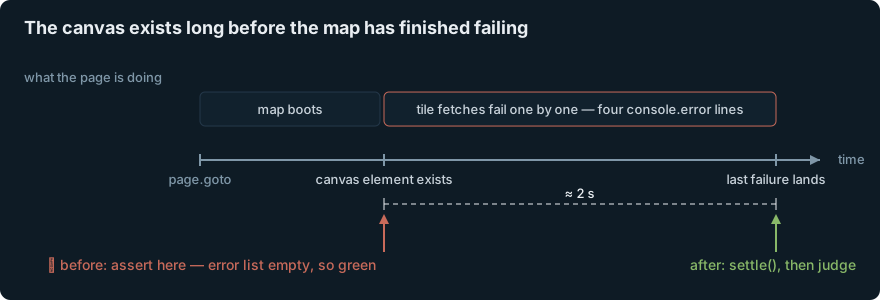
The fix separates collection from judgement — a watcher that starts before the
navigation and a settle() that drains every pending handle before anything is
asserted:
const settleMapErrors = watchErrors(mapPage);
await mapPage.goto(`${URL}/map`);
await mapPage.waitForSelector(".map-canvas .maplibregl-canvas", { timeout: 10_000 });
// The canvas appears well before the map has finished failing its external
// fetches, so asserting the instant it exists passed for the wrong reason.
const mapErrors = await settleMapErrors();
assert.deepEqual(mapErrors, []);
(The same commit fixed why those errors were unreadable in the first place:
Puppeteer’s msg.text() renders an object argument as its class name, so
MapLibre’s minified AJAXError arrived as [object Ae] with the host it named
invisible to the noise classifier. Resolving each argument through its
JSHandle makes collection async, which is what forces the settle-then-judge
shape anyway —
32bfe09.)
Rule: an assertion is a claim about an instant. If the system is still working when you sample, you measured a different system. Collect over a window, settle, then judge — and be suspicious of any wait keyed on the first sign of life rather than the last.
6. When deleting the fix leaves every check green
Same app, same evening. resolvePinStates called with no dependency object let
every unsynced station fall through to a live upstream fetch — a request storm
on every map open, throttled behind a ~24 req/min limiter, with a single
setData gated on the slowest of them. In review the pins effectively never
coloured. The fix is one argument: a rejecting fetchFn that makes state reads
cache-only, so an unsynced station stays neutral, which is the honest unknown
(afa3df1).
Now: which check catches its removal?
tsc— green. The argument is optional.- The Vitest suite — green. jsdom has no WebGL, so the map component never mounts and no test observes the call.
- The production build — green.
- The Puppeteer smoke test — green. A request storm against a third-party API is not a console error.
Delete the fix and all four stay green while the storm comes back. The bug is invisible to every conventional layer, which means writing a conventional test would be theatre. So the guard reads the source file as text:
it("resolves pin states cache-only — never fetching", () => {
  // Guarded by source text because nothing else can catch it: jsdom has no
  // WebGL so the map never mounts, and dropping the fetchFn leaves tsc, the
  // suite, the build and the smoke test all green while every map open fires
  // one live request per unsynced station at a third-party API.
  const src = readFileSync(join(__dirname, "MapScreen.tsx"), "utf8");
  const call = src.match(/resolvePinStates\([\s\S]*?\)\s*\n\s*\.then/);
  expect(call, "resolvePinStates call site not found").toBeTruthy();
  expect(call![0]).toContain("fetchFn");
});
That test is ugly. It’s coupled to formatting, it can’t see a rename, and it
proves nothing about behaviour. It is also the only thing in the repo that goes
red when the fix is removed
(88ec107).
Rule: if you delete the fix and nothing goes red, the missing thing is the check, not the bug. A real guard with a known ceiling beats an elegant guard that doesn’t exist — as long as the test says, in the test, why it’s shaped that way.
What they have in common
None of these were flaky. None were wrong answers. Every one of them was a scope bug in the check itself: the set of things examined was smaller than the set of things claimed, and nothing in the output distinguished the two.
That’s the whole thesis. A green check is a claim about what ran. Reading it as a claim about what’s true requires an extra assumption — that the check’s subject and the check’s coverage are the same set — and that assumption is exactly what nobody verifies, because verifying it feels like testing the tests.
Two structural tells show up in five of the six:
- The check consumed a partial data source and had no way to say so. The clipped coastline, the lock file, the jsdom environment, the two-second window. Partial coverage plus a boolean result is a machine for manufacturing false confidence.
- Nobody had ever watched it fail. The negative control caught #4 within a minute. It would have caught #1, #2 and #3 just as fast.
The checklist
Six questions. They take a minute, and each one is a bug I actually shipped:
- Does this validator iterate both sides of the pair? Or does it loop over one collection and silently exempt everything the other one knows about?
- Can this predicate return “no” and “I don’t know” as the same value? If yes, every caller reading it as a verdict is reporting a result nobody computed.
- Does the score examine the result, or just the call? Set containment on tool names, exit codes, “did it get called” — all of these pass on an empty payload.
- Did you run the negative control? Break the thing, watch the check go red, put it back. If you’ve never seen it fail, you don’t know it can.
- Does the assertion fire after the system has finished, or at the first sign of life? Waiting on the first artifact to appear is not the same as waiting for the work to finish.
- If you deleted the fix, which check would go red? If the honest answer is “none”, write that check first — even if the only shape available is an ugly one.
None of this is exotic. It’s the difference between a test suite that tells you the code works and one that tells you the suite ran.
I’m building the software stack for an all-electric charter catamaran — data packages, SignalK plugins, MCP servers, an offline tide app — mostly in public. Code for the bugs above lives in station-corrections, signalk-mcp and slackwater-web.
Related: Porting a tide engine to Swift with the original as the test oracle — what a check looks like when it does examine the result · Monitor the delivery path, not just the alarm — the same silence, one layer out · Bench your own workload before you switch LLM vendors — the benchmark from vignette 3, before its scoring blind spot showed up