Drop the vendor station ID: licensing as a data-model constraint
TL;DR —
@sailingnaturali/station-corrections2.0.0 deletedproviderId, the one field in a public MIT registry that pointed into a provider’s database. Consumers now join records by station name and resolve the provider’s opaque handle at runtime, under their own licence to that API. It cost a major version and reshaped four repos — and it’s a stronger control than a compliance note in a README, because the id can’t leak from a field that doesn’t exist. Jump to the fix.
“Don’t redistribute the vendor’s identifiers” is normally a compliance checkbox — a line in a NOTICE file, a paragraph in a licence audit, nothing that touches code. This one turned into an architecture. Here’s what it actually cost, and what it bought.
Problem
station-corrections is a small public npm package that publishes station identity for tide and current stations in the Salish Sea: the friendly name, the corrected position, search aliases, and a stable key that URLs and caches key on. Every record looked like this:
chs-dodd-narrows:
  name: Dodd Narrows
  context: Nanaimo
  position: [49.1344, -123.8171]
  provider: chs
  providerId: 63aef1866a2b9417c035030f
The package ships a PROVENANCE.md that walks the schema field by field and says where each value came from, because the whole claim of the package is these are our own facts, not a copy of anyone’s station export. Names are hand-written. Contexts and aliases don’t exist in provider data at all. Positions come out of a harmonic-fitting pipeline and get audited against a bundled coastline by a person.
And then there was one row that read differently:
| `providerId`, `providerBin` | **The provider's own opaque handle**, necessarily obtained from the
  provider because it keys the provider's API (`63aef09f…` for CHS, `PUG1717` for NOAA). It is a
  reference/pointer — the minimum needed to be interoperable — and a fact. This is the one field
  that points *into* a provider's system, by construction. |
The contributor guide made the exception explicit:
- The `providerId` is the exception — it is the provider's handle and there is nowhere else
  to get it. That is expected and fine.
The Canadian data behind those hex strings comes from the Canadian Hydrographic Service’s IWLS API, whose licence agreement is a bespoke Crown licence, not the Open Government Licence. Clause 3 is one sentence long:
The copyrights of CHS in the Data remain the property of CHS and shall not be
sold, licensed, leased, assigned or given to a third party.
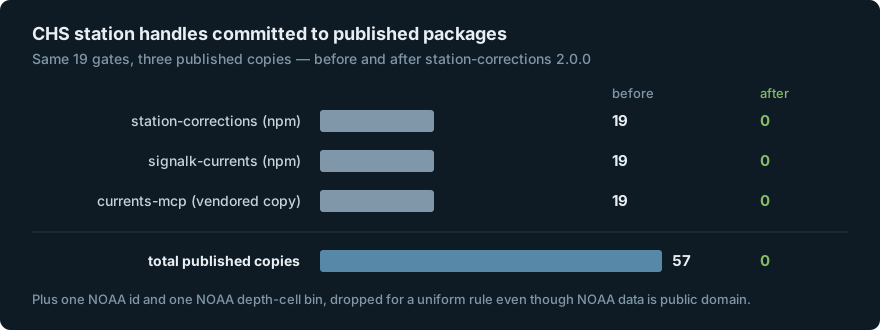
An MIT npm package is, structurally, giving something to third parties. Nineteen CHS station handles were sitting in it, then re-published in a SignalK plugin’s defaults.ts, then re-published again in a Python MCP server’s vendored copy of the registry — fifty-seven committed copies of the same nineteen handles, across three packages anyone can npm install or pip install.
Diagnosis
Two things were true at once, and only noticing both makes the fix obvious.
One: an id is the weakest thing you can defend as “just a fact.” The provenance doc leans on Feist (US) and CCH (Canada) — facts aren’t copyrightable, and neither jurisdiction has an EU-style database right. That argument is strong for a position (independently derivable: chart, gazetteer, direct observation) and strong for a name (hand-written editorial work). It’s weakest exactly where the contributor guide admitted the weakness: there is nowhere else to get it. A field whose only possible provenance is the vendor’s database is the field where “we obtained this independently” stops being available as a defence. The sentence written to justify the exception is a precise statement of why the exception is the problem.
Two: the field was doing two jobs. It was the identity of a station — what caches, resource keys and cross-package joins keyed on — and it was the fetch handle the provider’s API wants in a URL path. Those are different lifetimes. Identity should be stable forever and safe in a URL. A fetch handle is whatever the vendor’s index says today. Conflating them is what made the id feel load-bearing and undeletable.
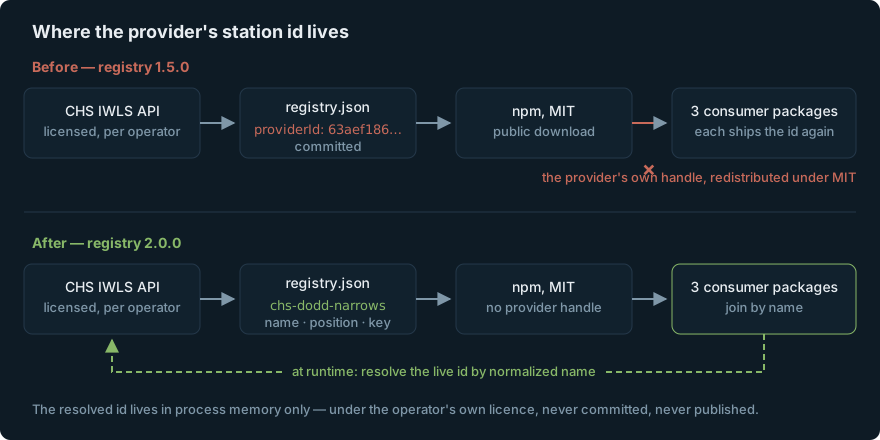
Separate the two jobs and the licence problem dissolves: the identity half is our own fact and publishable, the fetch-handle half never needs to be written down.
What we tried (and why it failed)
Attempt 1: document the exception harder. The first response was the provenance table above — a careful, honest, field-by-field account ending in “carried because interoperability requires them.” It’s good documentation and it moves zero bytes. The published tarball is identical before and after you write it. A README does not change what a package distributes, and clause 3 is about what you distribute.
Attempt 2: just delete the field. This is where it stops being a paperwork exercise. The plugin’s entire online path is keyed on that id:
const defaultFetcher: DayFetcher = async (s, a, b) =>
  s.provider === 'chs'
    ? { events: await fetchChsEvents(s.stationId, a, b) }
    : fetchNoaaEvents(s.stationId, s.noaaBin ?? 0, a, b);
Delete providerId and there is no stationId to fetch with — you don’t get a compile error in the registry package, you get a plugin that can no longer answer “when is slack at Dodd Narrows?” at all, online or off. The design spec had to spell out the three separate things a gate needs at runtime before anything could be removed:
Need                      | Old source (deleted)   | New source
--------------------------|------------------------|----------------------------------------
name / position / label   | defaults.ts            | station-corrections (by name/key)
live CHS id (online fetch)| defaults.ts stationId  | resolved live from IWLS /stations by name
offline constituents      | did not exist          | operator-triggered local build
The sibling fitting library had the same coupling, expressed as a guard that required the id to be present:
if (!key?.trim() || !entry.name?.trim() || !entry.providerId?.trim()) {
  throw new Error(`registry entry ${JSON.stringify(key)} has an empty key, name, or providerId`);
}
return { id: entry.providerId, label: entry.name, key };
Attempt 3: keep the id, but only where it’s public domain. NOAA data is US-government public domain — PUG1717 is genuinely free to redistribute. So carve out CHS and keep the field for NOAA rows. This was rejected, and the reason is worth stating: a schema field whose legality depends on which row you’re looking at is a field every future contributor has to reason about correctly, forever, in a package that takes drive-by PRs from anyone who spots a wrong station name. PUG1717 and its depth-cell bin came out too. The rule in the shared package is uniform — no provider-minted identifier, ever — and the one consumer that genuinely may ship a NOAA id keeps it in its own package, where the provider is fixed and the reasoning is local.
Attempt 4: assume the two provider endpoints share an id namespace. The plugin lists stations from api-iwls.dfo-mpo.gc.ca but fetches events from api-sine.dfo-mpo.gc.ca. If those two mint different ids, “resolve from IWLS, fetch from SINE” returns an empty array for every gate — no error, no 404, just currents quietly gone. That is not a thing to find out after wiring four repos together, so it got a throwaway probe first:
const stations = await (await fetch(`${IWLS}/stations`)).json();
const dodd = stations.find((s) => s.officialName === "Dodd Narrows");
const resp = await fetch(`${SINE}/stations/${dodd.id}/data?${params}`);
console.log(rows.length > 0 ? "PASS: shared id namespace" : "FAIL: ids differ — move event fetch to IWLS");
Twenty-three lines, one request, PASS. Had it failed, the live event fetch would have moved to IWLS as well — a different plan entirely, and much cheaper to discover before the refactor than during it.
The fix
1. The registry ships identity and nothing else. Two feat! commits and a major version:
chs-dodd-narrows:
  name: Dodd Narrows
  context: Nanaimo
  position: [49.1344, -123.8171]
  provider: chs
provider stays — “this is a CHS gate” is a fact about the world and tells a consumer which API to go ask. The validator drops providerId from its required-fields list and deletes the providerBin range check entirely. PROVENANCE.md’s exception row became a prohibition:
| provider id | **Deliberately absent.** The registry carries no provider-minted identifier at
  all — not even as a reference. A consumer joins a record here to a provider's live data by
  name; the provider's own opaque handle is resolved at runtime by whoever holds a licence to
  that provider's API, and it never enters this repository. |
2. Consumers split identity from the fetch handle. In the SignalK plugin, stationId becomes the stable registry key and a new liveId carries the ephemeral one:
// Ephemeral IWLS station id for a CHS gate, resolved live at runtime (see
// resolveLiveIds). NEVER committed. `stationId` above is the stable identity
// (registry key for CHS); `liveId` is only the fetch handle.
liveId?: string;
const chsLiveId = (s: StationConfig): string => {
  if (!s.liveId) throw new Error(`no live id for ${s.label}`);
  return s.liveId;
};
That throw is the enforcement. There is no path where a CHS fetch silently falls back to something committed, because there is nothing committed to fall back to.
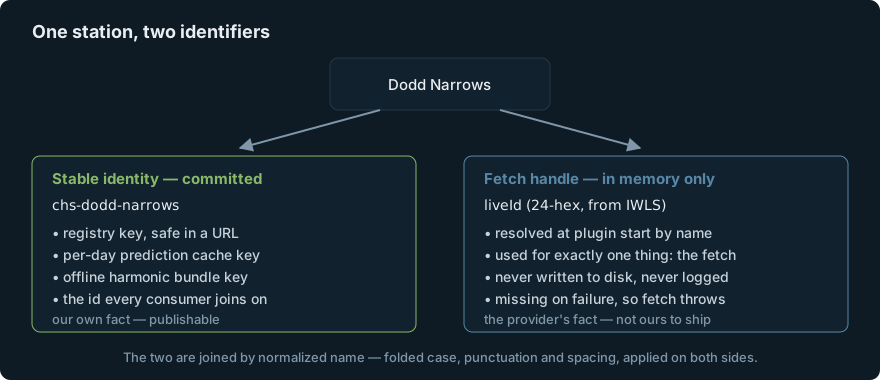
3. Resolve the handle at runtime, from the provider, by name. The whole resolver is twenty-odd lines:
export function currentStations(raw: RawStation[]): IwlsStation[] {
  return raw
    .filter((s) => (s.timeSeries ?? []).some((t) => t.code === 'wcsp1'))
    .map(({ id, officialName, latitude, longitude }) => ({ id, officialName, latitude, longitude }));
}

export async function resolveLiveIds(fetchFn: typeof fetch = fetch): Promise<Map<string, string>> {
  const resp = await fetchFn(`${IWLS_BASE}/stations`);
  if (!resp.ok) throw new Error(`IWLS ${resp.status}`);
  const stations = currentStations((await resp.json()) as RawStation[]);
  return new Map(stations.map((s) => [normalizeName(s.officialName), s.id]));
}
It runs at start(), holds the map in memory for the life of the process, and tolerates failure by falling through to the offline path. The id never reaches a file.
4. One normalizer, applied symmetrically, in every language that joins. TypeScript:
// Same folding rule chs-constituents uses, so "JUAN DE FUCA - EAST" matches the
// registry's "Juan de Fuca - East".
export function normalizeName(name: string): string {
  return name.toLowerCase().replace(/[^a-z0-9]+/g, ' ').trim();
}
Python, in the MCP server that reads the plugin’s /currents resource and joins each reading back to a registry gate:
def _norm(name: str) -> str:
    """Join key for correlating a gate to a plugin reading: fold case and trim
    so a label/name that differs only in casing or spacing still matches."""
    return name.strip().casefold()
Applied on both sides — once when the cache is built, once on lookup — so a whitespace difference between the plugin’s label and the registry’s name can’t silently drop a station.
5. Tests that keep it true rather than a rule that asks nicely. The fitting library’s overlay test asserts the absence directly:
it("keys entries by normalized name and reads no id at all", () => {
  // No providerId field anywhere — proves the overlay is forward-compatible
  // with the registry dropping providerId in Phase 2.
  const overlay = registryOverlay(
    { "chs-dodd-narrows": { name: "Dodd Narrows", provider: "chs" } },
    "chs",
  );
  expect(overlay.get("dodd narrows")).toEqual({ key: "chs-dodd-narrows", label: "Dodd Narrows" });
});
and the MCP server’s vendored copy of the registry is guarded by a drift test that fails the moment it stops byte-matching the published one.
Why it matters, and the gotchas
A licence term makes a better schema constraint than a policy. Compare “reviewers should check that nobody adds a provider id” against “the schema has no such field and the validator rejects unknown ones.” The second one survives a contributor who never read PROVENANCE.md, which is most of them.
Name joins are fragile exactly where ids are robust — so put the renames somewhere. An opaque id survives a rename; a name join doesn’t. The mitigation is that the registry is the thing that owns renaming: change a station’s display name there and every downstream package follows, because they all read it. What the join can’t survive is the provider renaming its station, and that is a real, unhandled failure mode — the gate goes offline-only until someone updates the registry name. The fitting library degrades gracefully (an unmatched live station keeps its official name and gets no key); the plugin logs and falls back. Neither pretends it matched.
Shipping the change broke the boat, twice, and both were migration bugs — not the design.
Nineteen duplicated gates. An operator config written before 2.0.0 still names a gate by its provider-minted UUID. That never collides with the registry’s slug, so both entries survived the merge, and the stale one resolved no live id either:
// Re-key such an entry onto the registry slug so it lands as the OVERRIDE it was
// always meant to be: the slug is what resolveLiveIds works from, and every other
// field the operator set (set directions, estimate flags, bins) rides along.
// Deliberately keyed on label, not position: renaming a station is the registry's
// job and downstream is supposed to follow it.
It was invisible for weeks because downstream consumers key on the label and silently keep whichever copy they saw last. When you re-key a shared identifier, write the migration for configs you don’t control — someone is running the old shape.
Ten stations throwing every poll cycle. The registry later grew tide reference ports alongside current gates. Tide ports publish no wcsp1 series, so resolveLiveIds finds nothing for them and the fetch guard fired ten times a cycle:
no live id for Point Atkinson
no live id for Campbell River
…
The fix wasn’t a filter in the plugin — that filter existed and was already wrong. Selection moved into the package that owns the data, as an exported currentGates(). If a package can grow a new row type, only that package can be trusted to say which rows are which.
Scrub the whole repo, not just src/. After the code was clean, a CHS id was still sitting in a fenced code sample inside an old implementation-plan doc, where no grep of the source would find it:
-  { provider: 'chs', stationId: '63aef1866a2b9417c035030f', label: 'Dodd Narrows', … },
+  { provider: 'chs', stationId: '<24-hex-id>', label: 'Dodd Narrows', … },
Docs, specs, plans, test fixtures, issue templates, commit messages. Grep for the shape of the thing, not the name of the field.
Make the invariant structural where you can. The offline harmonic bundle a user builds locally is written to the server’s data directory — outside the repo and outside the npm package — so it cannot be committed or published by accident. That’s not discipline, it’s geography, and geography doesn’t get tired.
The reward is the part nobody asks for. Because nothing downstream stores a provider handle any more, renaming a station is now a one-line PR in one repo, and the version of the package that made this legally safe is the same version that made renames free. That was not the goal; it fell out of deleting the field that pointed sideways into someone else’s database.
Built while putting a boat-agent stack together for an all-electric charter catamaran, where “the Canadian rapids stop working offline” is a licensing problem before it is a software one. The registry is station-corrections; the plugin is signalk-currents; the fitting pipeline that has to be run rather than downloaded is chs-constituents.
Related: Offline tidal currents from harmonic constituents — the same licence wall, one layer down, where it decides which predictions you can bundle at all. And the NOAA CO-OPS currents API gotchas for the other half of this cruising ground, where none of this applies.