A tidal gate with no current station: deriving slack from a tide port
TL;DR — Some tidal gates have no current station at all: the published knowledge is “slack is the reference tide port’s high water plus 25 minutes.” That is strictly less information than a fitted gate carries — no constituents, no flood/ebb axis, no speed — and the honest move is to model it as its own record type and carry the shortfall all the way to the agent’s answer rather than fabricating a zero. Jump to the fix.
Our tidal-currents pipeline had one entity type: a station with harmonic constituents. Feed it a CHS or NOAA current station, fit the constituents, and it will tell you the signed velocity at any instant — slack times, flood and ebb peaks, the set in degrees true. That model held for every gate in the Salish Sea until it hit one that doesn’t fit at all.
This is the follow-on to the offline-harmonic-fallback post, which built the fit path in the first place.
Problem
Malibu Rapids is the reversing rapids at the entrance to Princess Louisa Inlet — a blind S-shaped dogleg about 30 m across at its tightest, running 8 to 9 knots at springs. It is one of the most-asked-about gates in British Columbia, and CHS publishes no current station for it. There is nothing to fetch and nothing to fit.
Adding it to the shared station registry as an ordinary kind: current gate broke the plugin’s fetch cycle immediately, once per poll, forever:
signalk-currents: station Malibu Rapids live fetch failed: no live id for Malibu Rapids
The registry-to-station filter read only the provider field, so Malibu was swept straight into the list of things to fetch:
// src/registry-stations.ts — before
return Object.entries(data)
  .filter(([, e]) => e.provider === 'chs')
  .map(([key, e]) => ({ stationId: key, label: e.name, /* … */ }));
Downstream, the resolver has no CHS current id to hand back, and fetch.ts throws on the missing id:
// src/fetch.ts
if (!s.liveId) throw new Error(`no live id for ${s.label}`);
What is published for Malibu is a sentence out of the cruising literature: slack occurs about 25 minutes after high water at Point Atkinson, and 35 minutes after low water. A pointer and two numbers. No velocity series, no axis, no speed.
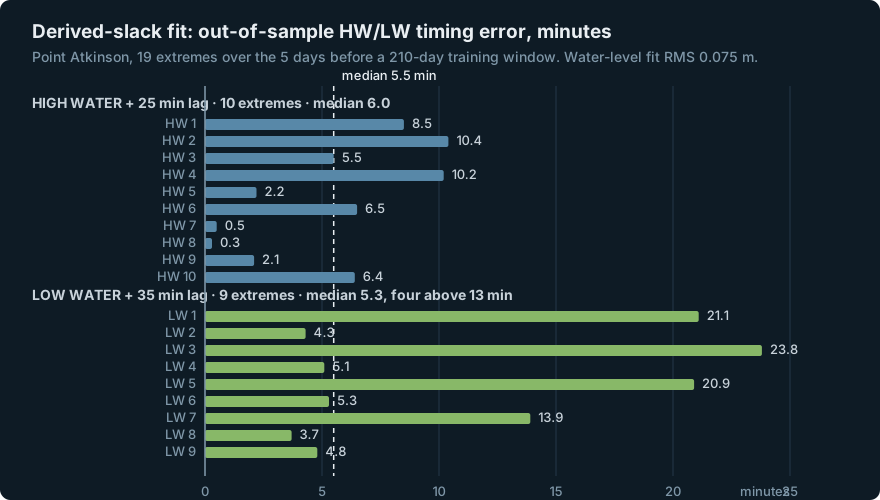 The reference-port fit is good enough that the lag, not the harmonics, is the dominant error term. The four outliers are all low waters — a flat extremum’s time is weakly determined at any accuracy.
Diagnosis
The whole chain — the registry, the fitting tool, the SignalK plugin, the MCP server, the agent’s spoken answer — assumed one shape: { constituents, floodDirection, ebbDirection, offset }. Everything downstream reads a signed velocity out of that. A derived gate breaks it in three separate places at once:
- No current series to fit. There is no
wcsp1velocity data for Malibu, so there are no constituents to produce. - No flood/ebb axis. A current station’s metadata carries
floodDirection/ebbDirectionbecause someone measured the channel’s major axis. Nobody measured Malibu’s. - No speed, ever. Not “unknown until we fetch it” — CHS predicts no current there at all. The information does not exist.
Point 3 is the one that matters. Points 1 and 2 you could paper over. Point 3 means any speed the pipeline emits is invented, and it would be invented at a pass where arriving off-slack pushes you into rock walls.
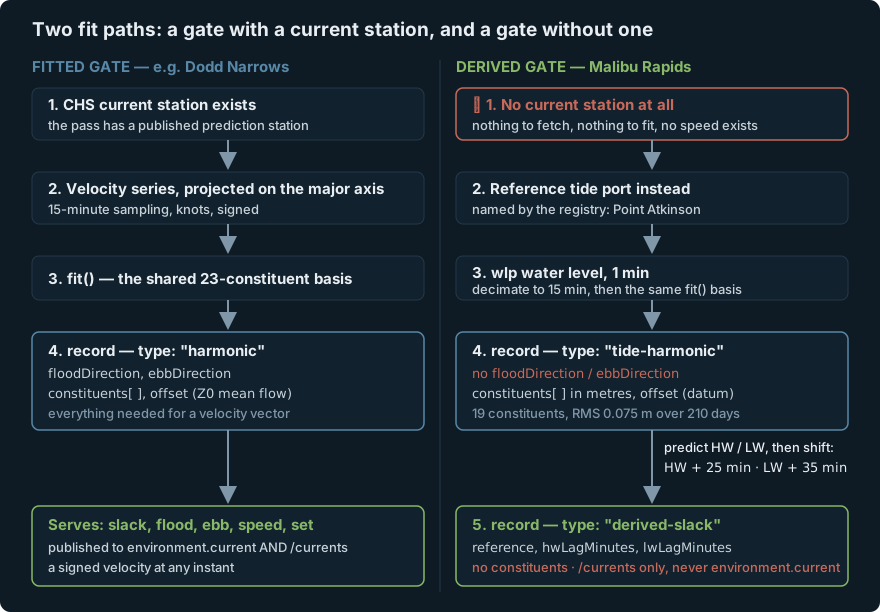
But the reference port does have a full water-level record. So the shape of the answer is: fit the reference tide offline, predict its high and low water, shift each by its lag, and publish the resulting times — and nothing else.
What we tried (and why it failed)
Attempt 1: filter it out. The first commit simply skipped any registry entry carrying a derived block, so the gate could exist in the shared registry without breaking anything that consumed it:
.filter(([, e]) => e.provider === 'chs' && e.derived === undefined)
This is correct as a guard and it shipped — but it is not a feature. The gate is in the registry and invisible to every consumer. Ask the agent about Malibu and you get “no station.”
Attempt 2: fake the missing fields. The tempting shortcut: emit an ordinary harmonic record with the tide’s constituents, floodDirection: 0, ebbDirection: 0, and let the existing machinery run. Everything downstream compiles, the resource publishes, the agent answers.
It also means environment.current starts publishing a speed and a set at a gate where nobody has ever predicted one, and a chart plotter draws a current arrow pointing due north because zero was the cheapest value to write. There is now a test whose entire job is to forbid this:
// test/fit-tide.test.ts
// A tide has no flood/ebb axis — those fields must be absent, not a fake 0.
expect(fitted).not.toHaveProperty('floodDirection');
expect(fitted).not.toHaveProperty('ebbDirection');
Attempt 3: reuse fitStation on the water-level series. The existing fit function looked reusable — same basis, same solver. It isn’t:
- it fetches a projected velocity series, not
wlp; - it calls
client.metadata(id)forfloodDirectionto project onto, and a tide port has no such field; wlpis sampled every minute against the current series’ 15, so the sparse-series guard (days * 96 * 0.6) computes the wrong minimum by a factor of 15 and a genuinely broken series would pass;- and the emitted record is typed
harmonicwith a flood/ebb axis it must not have.
That is four behavioural differences, which is a second function, not a flag.
Attempt 4: push the new records through the existing bundle adapter. The plugin’s adaptChsBundle validates strictly — deliberately, since a malformed bundle entry is a silently wrong prediction. Feeding it the two new record types produced exactly what strictness is for:
Error: CHS bundle station "chs-point-atkinson" is malformed
Error: CHS bundle station "chs-malibu-rapids" is malformed
Right call, wrong shape. The adapter had to learn there are now three kinds of record, not loosen its checks.
Attempt 5: let the presentation layer infer the missing pieces. The MCP server labels a slack window from the extrema on either side of it — “ebb→flood”. A derived gate has no flood or ebb events at all, so both neighbours are absent and the helper falls through to its default:
def _direction_label(prev_kind: str | None, next_kind: str | None) -> str:
    if prev_kind and next_kind:
        return f"{prev_kind}→{next_kind}"
    # …
    return "slack"
which the formatter then interpolated into its template, giving every Malibu window the tell-tale:
Wed 05:55 PDT (slack, slack)
That string is the missing information surfacing as a cosmetic bug. It is the cheapest possible signal that a type carrying less than its siblings had reached the top of the stack without anyone modelling the difference.
Attempt 6: ship the pairing in the data and the validator only. The registry gained the derived block and a tideReference field for ordinary gates, both validated. But neither appeared in index.d.ts, and resolve() — the one function the spec says returns a complete resolved record — dropped them. A typed consumer building a paired tide-and-current view could not see a gate’s reference port through the documented API, even though the data was right there in the JSON. Data plus validator is not a contract; the declarations are.
The fix
Four coordinated changes: a validated registry block, a second fit path, a record type that carries no constituents, and a flag propagated to the tool output.
1. The registry describes the derivation, and validates it
# data/registry.yaml
chs-malibu-rapids:
  name: Malibu Rapids
  context: Princess Louisa Inlet
  position: [50.1626, -123.8515]
  provider: chs
  kind: current
  aliases: [princess louisa, malibu islet]
  derived:
    reference: chs-point-atkinson
    hwLagMinutes: 25
    lwLagMinutes: 35
It stays kind: current — it is still a gate — but a consumer reads its slack from the reference, not from a fitted series. The validator refuses the ways this can be wrong:
if (record.kind === "tide") {
  problems.push(`${id}: a tide port cannot be derived`);
}
if (!isNonEmptyString(d.reference)) {
  problems.push(`${id}: derived.reference is required`);
} else if (!registry.has(d.reference)) {
  problems.push(`${id}: derived.reference "${d.reference}" is not a station in this registry`);
} else if (registry.get(d.reference).kind !== "tide") {
  problems.push(`${id}: derived.reference "${d.reference}" must be a tide port (kind: tide)`);
}
for (const field of ["hwLagMinutes", "lwLagMinutes"]) {
  if (typeof d[field] !== "number" || !Number.isFinite(d[field])) {
    problems.push(`${id}: derived.${field} must be a number`);
  }
}
A dangling reference or a reference that is itself a current station would derive slack from the wrong water, silently. It fails the build instead.
2. A second fit path for water level
fitTideStation fetches wlp, thins the 1-minute series to 15 minutes, fits the same constituent basis, and emits a record that is explicitly not a current:
/** wlp is 1-minute sampled; a harmonic fit wants nothing finer than this. */
const WLP_STEP_MINUTES = 15;

export async function fitTideStation(client, station, { start, days, stepMinutes = WLP_STEP_MINUTES }) {
  const series = await client.series(station.id, "wlp", start, days);
  const samples = decimate(series, stepMinutes);

  const minimum = Math.floor(days * (1440 / stepMinutes) * 0.6);
  if (samples.length < minimum) return null;          // a holey series is worse than none

  const result = fit(samples, { constituents: BASIS });
  return {
    id: station.key ?? slug(station.label),
    name: station.label,
    type: "tide-harmonic",     // not "harmonic"
    source: "chs-derived",
    offset: result.offset,     // the datum, recovered as Z0
    constituents: result.constituents.filter((c) => c.amplitude > MIN_AMPLITUDE),
    rms: result.rms,
    trainingDays: days,
  };
}
No floodDirection, no ebbDirection — absent, not zero. Over a 210-day window Point Atkinson fits to RMS 0.075 m on 19 constituents above the amplitude floor.
3. The record type that admits it knows less
/**
 * The bundle record for a derived gate: no constituents and no speed — a
 * consumer predicts the referenced tide port and derives slack from its HW/LW.
 * `tide-derived` (not `chs-derived`) marks that this record itself holds no CHS
 * data, only a pointer and the lags.
 */
export interface DerivedSlackRecord {
  id: string;
  name: string;
  type: "derived-slack";
  source: "tide-derived";
  reference: string;
  hwLagMinutes: number;
  lwLagMinutes: number;
}
Seven fields, none of them a measurement. That is the entire honest content of a derived gate.
4. Slack timing, and only slack timing, all the way out
In the plugin, derived gates get their own refresh pass, publish to the /currents resource with derived: true, and are structurally excluded from the environment.current path:
export function synthesizeDerivedEvents(gate: DerivedGate, tide: TideStation, start: Date, end: Date): CurrentEvent[] {
  const predictor = createTidePredictor(
    tide.constituents.map((c) => ({ name: c.name, amplitude: c.amplitudeKn, phase: c.phaseDeg })),
    { offset: tide.z0M },
  );
  return predictor
    .getExtremesPrediction({ start, end })
    .map((x) => {
      const lagMs = (x.high ? gate.hwLagMinutes : gate.lwLagMinutes) * 60_000;
      return eventFromParts(new Date(x.time.getTime() + lagMs).toISOString(), 'slack', 0);
    })
    .sort((a, b) => a.utc.localeCompare(b.utc));
}
Every event is a slack with a speed of exactly 0, and there are no flood or ebb events to be a peak of. The MCP server picks up the flag and states the limitation in words the agent can read out:
if await currents.derived_for_station(gate.name):
    out["derived"] = True
    out["derived_display"] = (
        "Slack timing only — this pass has no current station, so its slack is "
        "derived from a reference tide port's high/low water. No current speed "
        "or set is predicted."
    )
So the answer a skipper gets is slack windows plus an explicit statement of what is missing, instead of a confident bearing:
Malibu Rapids — slack timing only (derived from Point Atkinson HW/LW)
  Wed 05:55 PDT (slack)
  Wed 11:25 PDT (slack)
  flood_dir_true: null    ebb_dir_true: null
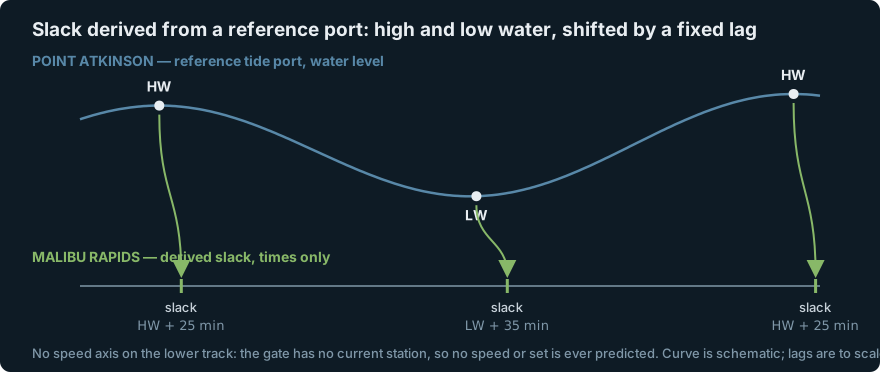 Schematic — the curve shape is illustrative, not plotted CHS prediction data.
Why it matters, and the traps nearby
Represent “less information” as a type, not as a sentinel. Every shortcut here — a zero flood direction, a zero speed on an ordinary record, an empty constituent array — types cleanly and reads as data downstream. A separate record type is the only version where the compiler, the validator, and the tool output all agree about what is unknown. The (slack, slack) string was the system telling us, in the cheapest possible way, that a type mismatch had reached the presentation layer.
Measure the fit even when the accuracy story is about something else. The harmonic fit at the reference port is not the weak link here — I re-checked it against CHS predictions over the five days immediately before the 210-day training window, entirely out of sample:
n 19 median 5.5 min mean 8.2 min max 23.8 min
The four worst cases are all low waters. A flat extremum’s time is poorly determined by anything, including CHS’s own published tables. The dominant uncertainty is the lag, which comes from the cruising literature and community consensus — not from a CHS product — so the pass entry in our vault carries a source confidence: medium and says where the numbers came from. Fitting to six minutes and then shifting by a number good to maybe fifteen tells you where to spend the next hour, and it isn’t on more constituents.
getExtremesPrediction’s prominence filter is window-relative. Extremes near the edge of the requested window can be dropped or kept depending on the window itself, so a high water just outside the horizon whose shifted slack lands inside it goes missing. The horizon function pads by the largest lag plus an hour, then clips:
const pad = Math.max(gate.hwLagMinutes, gate.lwLagMinutes) * 60_000 + 3600_000;
const events = synthesizeDerivedEvents(gate, tide, new Date(base.getTime() - pad), new Date(end.getTime() + pad))
  .filter((e) => {
    const t = new Date(e.utc).getTime();
    return t >= base.getTime() && t <= end.getTime();
  });
The same bites the test: a test that recomputes the expected extremes over a different window disagrees with the implementation at the edges, for reasons that have nothing to do with the code under test. Match the padded window exactly.
Watch for a field name that already means something else. Surfacing the pairing through resolve() ran straight into a collision — derived on the resolved record was already a gazetteer-context boolean. The slack block is therefore surfaced as an effective tideReference, resolving to a gate’s explicit pairing or a derived gate’s derived.reference, and the raw block is not re-exposed under the colliding name:
/**
 * The effective reference tide port for a paired tide+current view — the
 * registry key of a current gate's `tideReference`, or, for a gate whose
 * slack is derived, its `derived.reference`. Present only when the gate names
 * one; a tide port and a genuinely unpaired gate carry none.
 */
tideReference?: string;
Curated pairings only. The same change annotated nine ordinary gates with the tide port they’re displayed beside — Seymour Narrows to Campbell River, Sechelt Rapids to Point Atkinson, and so on — each the nearest kind: tide reference port in the gate’s own regime, verified against the positions in the file. Nearest-by-haversine would have been one line of code and wrong at least twice; a guessed pairing pointing at the wrong side of an island is worse than no pairing at all.
Close
This is one gate on the boat’s currents stack — the one that finally forced the pipeline to admit that its entities are not all the same shape. The registry is station-corrections, the fitting tool is chs-constituents, and the two consumers are signalk-currents and currents-mcp — all MIT, all built for an all-electric charter catamaran that will eventually have to transit that dogleg on the right minute.
Related: Offline tidal currents from harmonic constituents — and when not to trust them · Two tidal libraries disagreed: diff their internals, not their outputs.